Bringing Real-World Complexity into the Lab
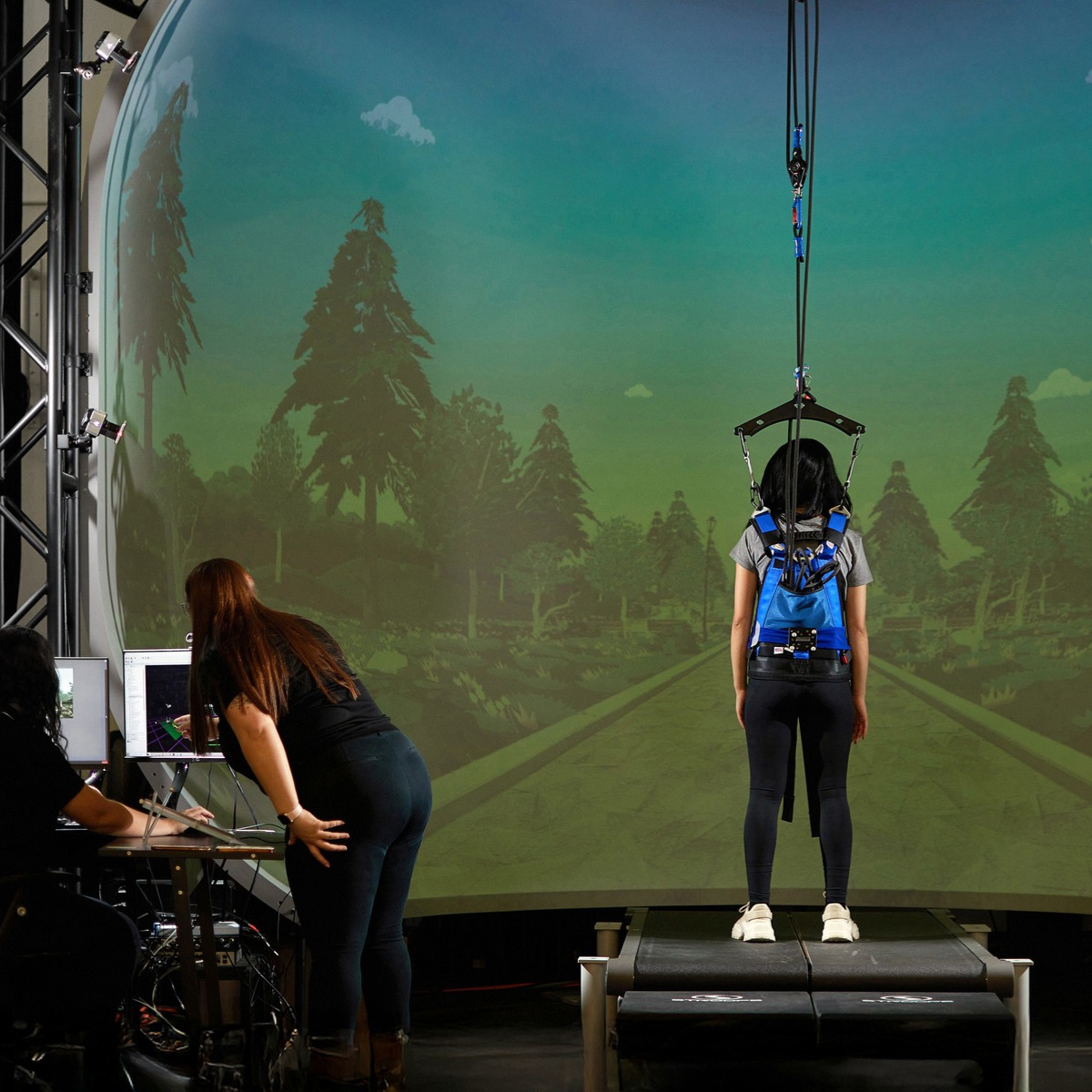
What if you could safely test how someone navigates a busy sidewalk or reacts to an unexpected trip without putting them at risk? That is the power of virtual reality (VR) gait analysis, and it comes to life inside the Bertec Immersive Labs Dome. Available in 4-meter and 5-meter configurations, the dome surrounds participants with a 205-degree field of view, creating an immersive environment that supports realistic movement challenges while preserving laboratory control. By blending controlled biomechanics measurement with immersive, real-world challenges, researchers can explore human movement in ways traditional labs can’t match.. As Product Manager Meghan Lukac at Bertec says, “Our goal was to create a tool that gives researchers more flexibility and control in how they study movement, without adding complexity to their workflow.”
Customized Virtual Environments
Pairing the Fully Instrumented Treadmill v5 (FIT5) with the Immersive Labs Dome enables researchers to recreate everyday environments while maintaining the precision of laboratory-grade data. With the ability to customize unique Unity® scenes, users can create tailored virtual environments such as hallways, parks, or sidewalks, to meet the needs of their specific study. These environments help researchers study walking behavior under realistic visual and spatial constraints, while maintaining complete experimental control.
Repeatable Testing Scenarios with Kinamoto™
Kinamoto™ brings all aspects of the VR gait experience into a single software platform with integrated treadmill controls, virtual scene management, and synchronized data collection. In addition to its on-demand controls, Kinamoto’s Protocol Builder enables researchers to design repeatable, experiment-specific protocols that adjust treadmill speed, modify scene elements, or display visual stimuli based on forces, body position, or other inputs. Video-based keypoint tracking further enhances this adaptability by monitoring participant position in the virtual environment driving changes to the treadmill or scene behavior.
Dual Task Training Made Easy
The VR environment provides a clear method for researching dual-tasking by layering visual challenges onto standard walking tasks. Researchers can introduce scene rotations, treadmill perturbations, and visual or auditory distractions to mimic real-world demands. These controlled manipulations may help uncover how attention, perception, and decision-making influence gait. It’s a powerful approach for integrating the reality of people’s busy lives into human movement research.
Advancing Human Movement Research
By combining immersive VR and precise measurement tools, researchers gain a new way to study how people move in realistic yet controlled conditions. Whether exploring dynamic environments, designing repeatable protocols, or evaluating dual-task performance, VR-based gait analysis offers valuable depth to the study of human movement. As the field continues to expand into rehabilitation and performance applications, these capabilities open the door to more meaningful insights across biomechanics research.
Learn more about our Immersive Labs here