Passive vs Active Head Turns in Gaze Stabilization and Dynamic Visual Acuity Testing
The Gaze Stabilization Test (GST) and Dynamic Visual Acuity Test (DVAT) are core components of visual-vestibular assessment and are often integrated into vision training therapy programs. These tests evaluate the vestibulo-ocular reflex by measuring how well a person can maintain clear vision during rapid head movement.
In the Bertec Balance Advantage system, GST and DVAT can be performed using either passive or active head turns. The testing procedure, equipment, and visual feedback remain the same. The only difference is whether the practitioner moves the patient’s head (passive) or the patient moves their own head (active). Understanding when and why to use each method helps clinicians get the most out of these assessments.
“With Bertec’s technology, clinicians can tailor each test to match the patient’s needs—whether identifying subtle deficits or optimizing performance for return-to-play decisions,” says Aysun Dolan, Bertec Product Specialist.
Visual feedback system
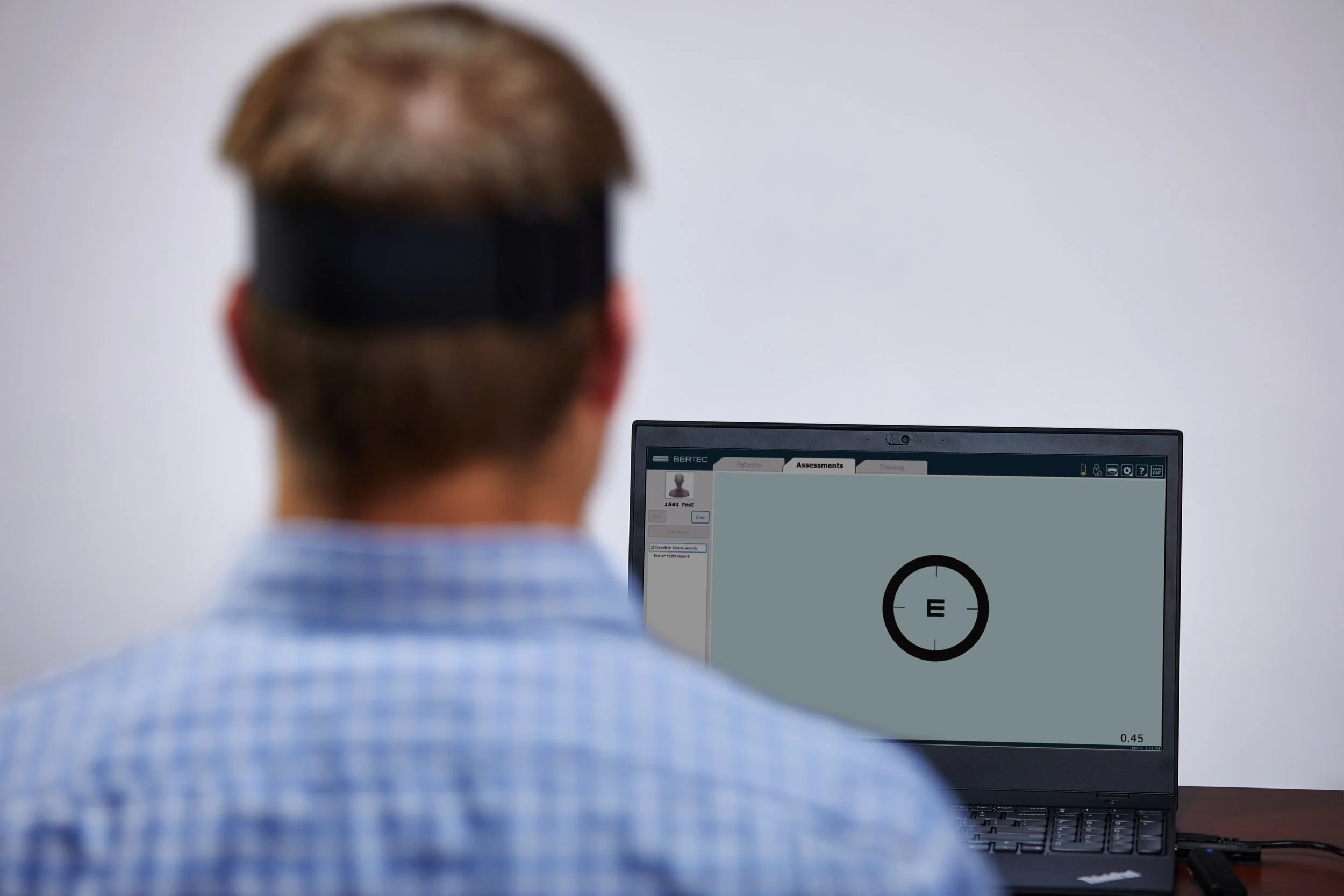
During both passive and active testing, the Bertec system provides real-time visual feedback to ensure that head movements meet target velocity requirements:
The concentric circle is gray when the head velocity is within the accepted range.
The concentric circle changes color based on head velocity:
A black ring appears when the head velocity is below the target range.
A white ring appears when the head velocity is above the target range.
This feedback helps guide both the practitioner and the patient to maintain consistent and valid movement speeds.
Active head turns
In active testing, the patient moves their head in the pitch, yaw or roll direction while identifying optotypes on the screen.
Advantages:
Reflects real-world movement and functional performance
Encourages engagement of compensatory strategies, such as anticipatory motor control
Commonly used in vision training therapy to guide progress and customize exercises
Considerations:
Requires the patient to understand the task and perform consistent, self-driven movements
Compensation may mask underlying vestibular deficits, especially in chronic cases
For instrumented testing, such as BVA, imposes a dual-tasking burden on the subjects by asking them to use the visual feedback and modify their head movements
Passive head turns
In passive testing, the clinician moves the patient’s head while the patient remains relaxed and focused on the visual target. The clinician is responsible for maintaining proper head velocity using the same visual feedback cues.
Advantages:
Minimizes compensatory control from the patient
Allows clearer identification of impairments in the vestibulo-ocular reflex
Useful in early evaluation stages or when active movement is unreliable
Considerations:
Less representative of natural movement patterns
Requires clinician skill to maintain test validity using feedback cues
When to use each method
Both testing methods are valid and supported by the Bertec system. The choice depends on the purpose of the assessment and the patient’s current abilities.
Use passive head turns when:
Assessing baseline vestibular function
The patient is unable to generate consistent head movement
You want to minimize central compensation during testing
Use active head turns when:
Monitoring progress during vision training therapy
Evaluating functional performance and real-world relevance
Assessing the impact of central compensation on test outcomes
Final thoughts
The Gaze Stabilization and Dynamic Visual Acuity tests are essential tools in both assessments and vision training therapy. While the core test parameters remain the same, the choice between active and passive head movement can influence how clinicians interpret results and guide treatment. Using passive testing for assessment and activ teesting for training is a logical approach that can provide a more complete picture of the patient’s visual-vestibular system and support targeted, individualized care.